

Shoulder Pain After a Car Accident: What to Watch For
Published
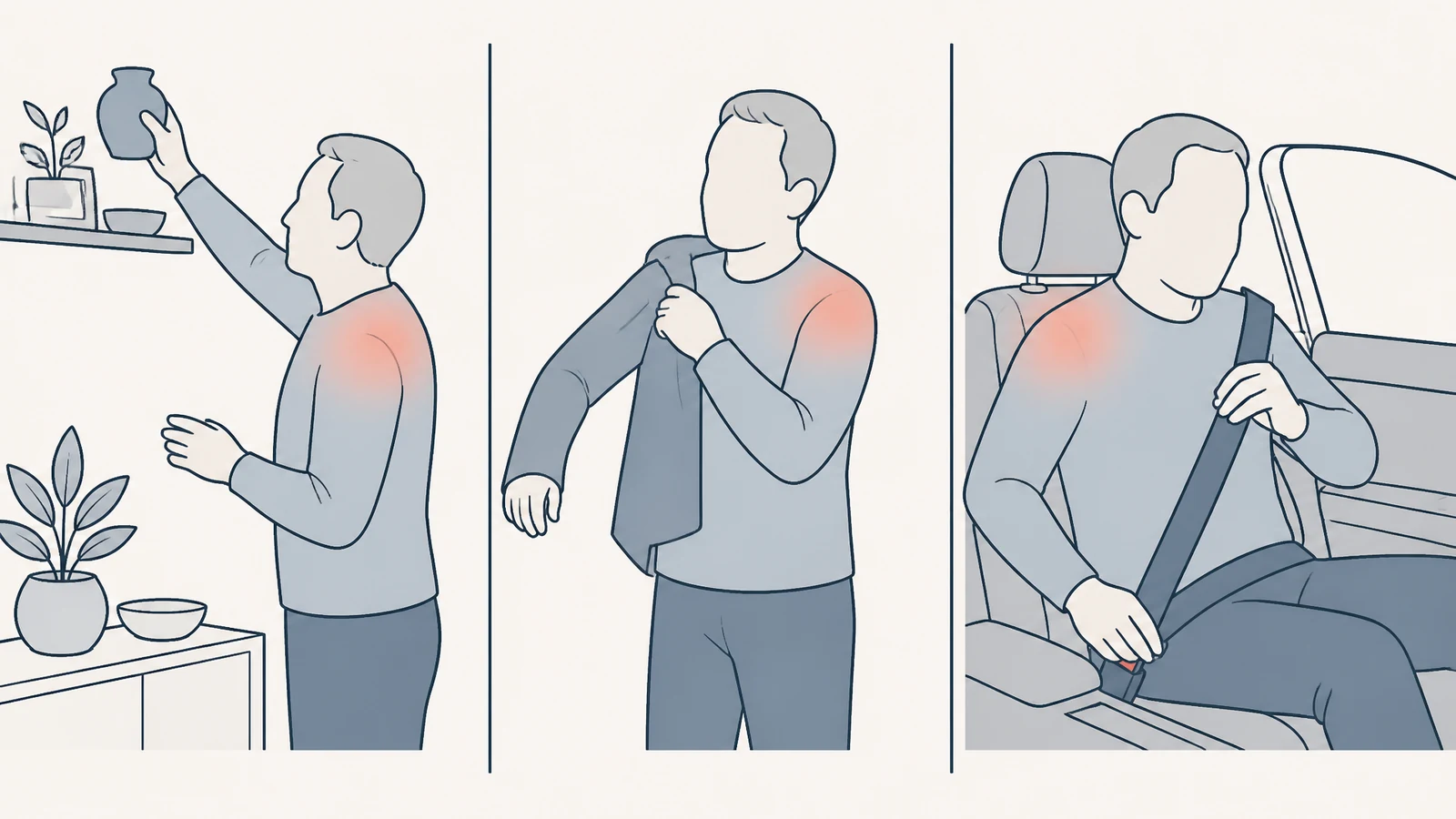
Everyday movement often makes shoulder symptoms easier to describe.
Shoulder pain after a collision can follow seatbelt loading, bracing, direct impact, or movement through the neck and upper back. Pain alone does not tell you which structure is involved. The useful questions are what movements hurt, whether strength or motion changed, whether symptoms travel from the neck, and whether the trauma suggests a fracture, dislocation, tendon injury, nerve problem, or another condition.
The shoulder and neck can overlap
Pain felt around the shoulder can come from the shoulder joint and surrounding soft tissues, but neck and nerve-related problems can also produce symptoms into the shoulder or arm. A focused exam should consider both areas when the history and symptom pattern call for it.
Use function to describe the shoulder problem before you name the structure
People often recognize a shoulder problem through an ordinary task before they know a medical term. Reaching to a shelf, putting on a shirt or jacket, fastening a seat belt, lifting a grocery bag, sleeping on one side, or reaching behind the body can reveal a change in motion, strength, or comfort.
Those details are useful because they describe function without pretending to identify the injured tissue. "I can raise my arm forward but not comfortably out to the side" gives a clinician something specific to examine. "I tore my rotator cuff" is a conclusion that requires supporting findings.
Shoulder symptoms and neck-related symptoms can behave differently
The overlap between the neck and shoulder is one reason a focused examination matters. A shoulder problem may be more obvious with reaching, lifting, rotation, or direct shoulder loading. Neck or nerve-related symptoms may be influenced by neck movement or may travel farther into the arm with numbness, tingling, or weakness. These are patterns to investigate, not rules that diagnose the source.
What should change the next step
A useful shoulder plan watches more than pain intensity. Changes in active motion, strength, ability to use the arm, sleep tolerance, work demands, and response to care can all affect the next decision. A sudden loss of function, progressive weakness, a visible deformity, circulation changes, or findings that do not fit a routine musculoskeletal pattern should move the conversation toward a different level of evaluation rather than simply adding more of the same treatment.
The practical question is not "Which shoulder injury do I have based on this article?" It is "What changed in how my arm works, and what does the examination show?"
Some shoulder symptoms need urgent medical evaluation
A visible deformity, suspected fracture or dislocation, severe swelling, loss of circulation, major weakness immediately after trauma, or other emergency findings need urgent medical evaluation. A chiropractic appointment is not a substitute for emergency or orthopedic care when those findings are present.
Imaging is a clinical decision, not an automatic step
X-rays are useful for certain bone and joint questions but do not show every soft-tissue problem. MRI or other imaging may be appropriate when the examination raises a specific question that is likely to affect treatment or referral. Not every sore shoulder needs imaging, and a normal X-ray does not rule out every soft-tissue injury.
Conservative care should match the findings
When the problem fits non-emergency musculoskeletal care, treatment may include appropriate hands-on care, soft-tissue work, guided shoulder exercise, movement advice, or coordination with another provider. The plan should be tied to motion, strength, pain, and function and should change when those findings change.
There is no universal recovery clock
A minor strain and a significant tendon injury do not share the same recovery timeline. The actual injury, severity, health factors, activity demands, and response to care matter. Persistent weakness, loss of motion, worsening symptoms, or failure to progress should trigger reassessment rather than a promise that more time or more visits will automatically solve the problem.