

Chiropractic Care

Joint and Posture Care in Zanesville

Modern life is hard on the body in quiet ways. Sit too long and the hips tighten, the low back protests, the shoulders round forward. Move the wrong way and a knee, a shoulder, or a wrist starts to complain. There is a Goldilocks zone for the human body, and most of us live outside it. The work of chiropractic care is to find where the system is out of balance and help the body get back into a range it can actually function in. The strain shows up in predictable patterns, and most of those patterns respond to focused conservative care.

Please do not submit any protected health information (PHI) in this form.

By submitting, you agree to be contacted about your appointment. We respect your privacy.

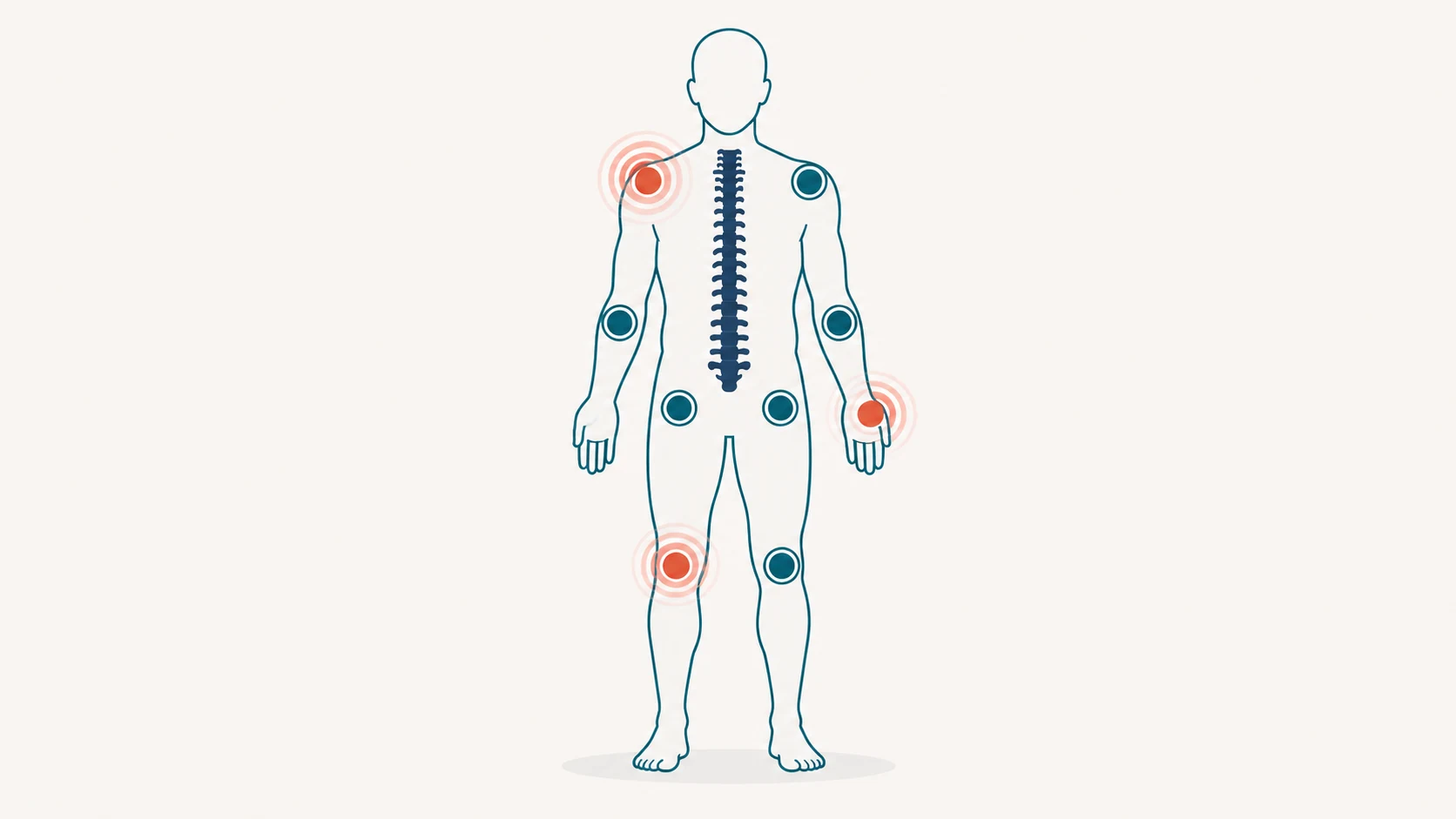
Illustration of a stylized human figure with major joints highlighted, showing the multi-location nature of joint and posture strain

Joints throughout the body, not just one location.

Modern life puts predictable strain on the system: shoulders from posture, wrists from typing, hips from sitting, knees from compensation. Most of it responds to focused conservative care once the pattern is identified. Call (740) 453-2900.

Where joint and posture issues come from

Too much of one thing. Prolonged sitting, prolonged standing, prolonged looking at a phone, prolonged anything. The body is built to move; staying in one position for hours creates strain patterns that the joints and surrounding muscles eventually feel.

Too much of the wrong thing. Repetitive motion at work — typing, lifting, reaching, painting — repetitive motion in sports or hobbies, the lifting pattern that finally caught up to you. Tissues handle a lot until they do not.

Not enough of anything. The slow loss of strength, flexibility, and joint function from a sedentary pattern. The body adapts to what you ask of it, and when you ask less, it gives less.

Compensation patterns. An old ankle injury that changes how you walk and eventually irritates the knee or the hip. A shoulder that hurts and changes how you move and eventually irritates the neck. Pain often shows up far from where the original problem started.

The aging body. Joints and tissues change over time, and that is normal. Most of the discomfort that shows up in your thirties, forties, and fifties is not aging itself; it is the accumulation of small patterns the body could absorb when you were twenty.

Finding the actual driver of the pattern is the difference between temporary relief and lasting recovery. A sore shoulder is sometimes a neck problem. A sore knee is sometimes a hip problem. The exam is the part that figures out which.

What chiropractic care does for joint and posture issues

The exam comes first. We look at how the body moves as a system, not just the spot that hurts. Joint motion, muscle balance, the related areas, the way you stand and walk. The picture that comes out of a thorough exam is usually broader than what the patient came in expecting.

Treatment is matched to what we find. Joint mobilization or adjustment where indicated for the affected joints and the related areas, soft-tissue work for the muscles that are pulling things out of balance, and targeted exercises for what is weak. Every piece is tied to the exam, not done for its own sake.

Posture and ergonomic guidance is the other half. The desk, the workstation, the lifting pattern, the way you sit and stand. The office work is part of it; what you change in your daily habits is what makes the change stick. For a second source on what chiropractic adjustment is and how it is used, the Cleveland Clinic overview of chiropractic adjustment is a useful starting point. For the broader picture of how we work, the chiropractic care page covers our approach across conditions.

Common patterns we see

Shoulder discomfort. Often from rotator cuff strain, repetitive overhead motion, sleeping on one side, or referred from the neck. Treating just the shoulder rarely fixes it; the neck and upper back are usually part of the picture, which is why our neck pain cases and shoulder cases overlap so often.

Wrist and forearm strain. From keyboarding, mouse use, manual labor, or repetitive grip. Often shows up as tendonitis-type discomfort. The ergonomic setup and the wrist position at rest matter as much as the work itself.

Hip stiffness. From prolonged sitting, weak glutes, or compensation for a low-back pattern. The hips are central to how the whole lower body moves; addressing them often resolves issues that look like knee or low-back problems.

Knee discomfort. Sometimes a knee problem, often a hip or ankle problem showing up at the knee. The way you move from the hip down determines how the knees age.

General posture concerns. Forward head, rounded shoulders, low-back overarching. These patterns are common and they are addressable, but they take consistency. The work is rarely about one big change; it is about small adjustments that hold. The same posture pattern that loads the neck and shoulders also drives a lot of everyday headaches.

Ergonomic and workspace strain. The neck-shoulder pain from a monitor that is too low, the wrist pain from a keyboard angle that is wrong, the low-back pain from a chair that does not support the lumbar spine. Often the simplest fixes have the biggest effect.

When joint or posture issues need more than chiropractic care

These signs do not necessarily mean something serious is wrong, but they mean a careful evaluation is needed before chiropractic treatment, and sometimes a medical doctor needs to be in the loop. We screen for all of these before starting care.

  • Sudden severe joint pain with swelling, redness, or warmth (possible infection or inflammatory condition)
  • Joint discomfort with fever
  • A joint that gives way or locks up
  • Numbness, tingling, or weakness in the arm, leg, hand, or foot
  • Pain after a fall or significant impact
  • Persistent night pain that does not respond to anything
  • Unexplained weight loss combined with joint pain

Small changes that matter

  • Set a timer to stand up every 30-45 minutes if you sit for work
  • Raise the monitor so the top of the screen is at eye level
  • Switch sides when carrying bags, lifting, or doing repetitive work
  • Strengthen what is weak (often the glutes and the deep core) more than stretching what is tight
  • Sleep position matters; a pillow that supports a neutral neck, and a pillow between the knees when side-sleeping, both help
  • If a discomfort has been around for more than a few weeks and is not getting better on its own, get evaluated
FAQ

Frequently Asked Questions

Common questions about joint, posture, and ergonomic care.

Can a chiropractor help with shoulder pain even though it is not the spine?

Yes. Chiropractic training covers the joints of the whole body, not just the spine, and the shoulder is one of the most common non-spinal regions we treat. The shoulder also rarely operates in isolation — the neck, upper back, and shoulder blade mechanics are usually part of the picture, which is exactly the kind of system view a chiropractic exam is built for. We address the shoulder itself with joint and soft-tissue work, and we address the related areas so the pattern actually changes.

What if my joint pain is from arthritis?

Arthritis is common, and chiropractic care does not cure it, but it can meaningfully improve how an arthritic joint feels and moves. The goal shifts: not reversing the joint changes, but reducing the surrounding muscle guarding, restoring motion in the related areas that are compensating, and giving you exercises that keep the joint as functional as possible. Many arthritis patients do well with periodic chiropractic care as part of a broader plan.

How do I know if my pain is from posture or from something more serious?

Posture-driven pain tends to build slowly, change with position (better when you move, worse when you hold one position), and respond to simple things like a break or a stretch. Pain from something more serious tends to be more constant, often worse at night, may come with swelling, redness, fever, numbness, or weakness, and does not respond to position change. The exam screens for the difference; that is part of why we do it before any treatment.

Can chiropractic care really change my posture?

It can, but the office work is only part of it. Posture is the sum of how your body has been used for years — the desk setup, the phone habit, the sleep position, which muscles are strong and which are not. Chiropractic care restores motion in restricted joints and addresses the muscle imbalances that hold poor posture in place. The lasting change comes from combining that with the daily habits you control. We give you specific guidance on what to change.

How long does it take to see improvement in joint or posture issues?

Most patients notice some change within the first two to four visits, especially in how the joint feels with movement. Lasting change usually takes four to eight weeks because the muscle balance and habit patterns driving the problem need time to shift. Long-standing posture patterns can take longer, and we are honest about that at the first visit based on what the exam shows.

Should I get an MRI or X-ray before coming in?

Usually not. Most joint and posture issues are diagnosed clinically — by history and exam — and imaging often shows age-related findings that are not the cause of the pain. We order imaging when the exam suggests it is needed, when red-flag signs are present, or when care is not progressing as expected. Coming in without imaging is normal and appropriate for most cases.

Ready to figure out where the pattern actually started? Get a focused exam and a real plan.

Same-day appointments available.