Auto Accident Care

Auto Accident Chiropractor in Zanesville

You were just in a car accident, and now you are sore, shaken, and fielding calls you did not ask for. Whether you hurt all over or you feel surprisingly fine, the next 72 hours are the window that matters most. That is when injuries like whiplash are easiest to catch, and when a clear medical record does the most to protect both your health and any claim you may end up filing. We see accident patients fast, evaluate what the crash actually did to you, document it carefully, and walk you through what comes next. No guesswork, no runaround.

  • Same-day and walk-in appointments, because the first days count
  • Focused evaluation of whiplash, soft tissue, and spinal injuries
  • Detailed medical records for your own files and any claim
  • Coordination with your attorney or insurance, when you want it
  • Letter of protection for qualifying cases, so care does not wait on money

Please do not submit any protected health information (PHI) in this form.

By submitting, you agree to be contacted about your appointment. We respect your privacy.

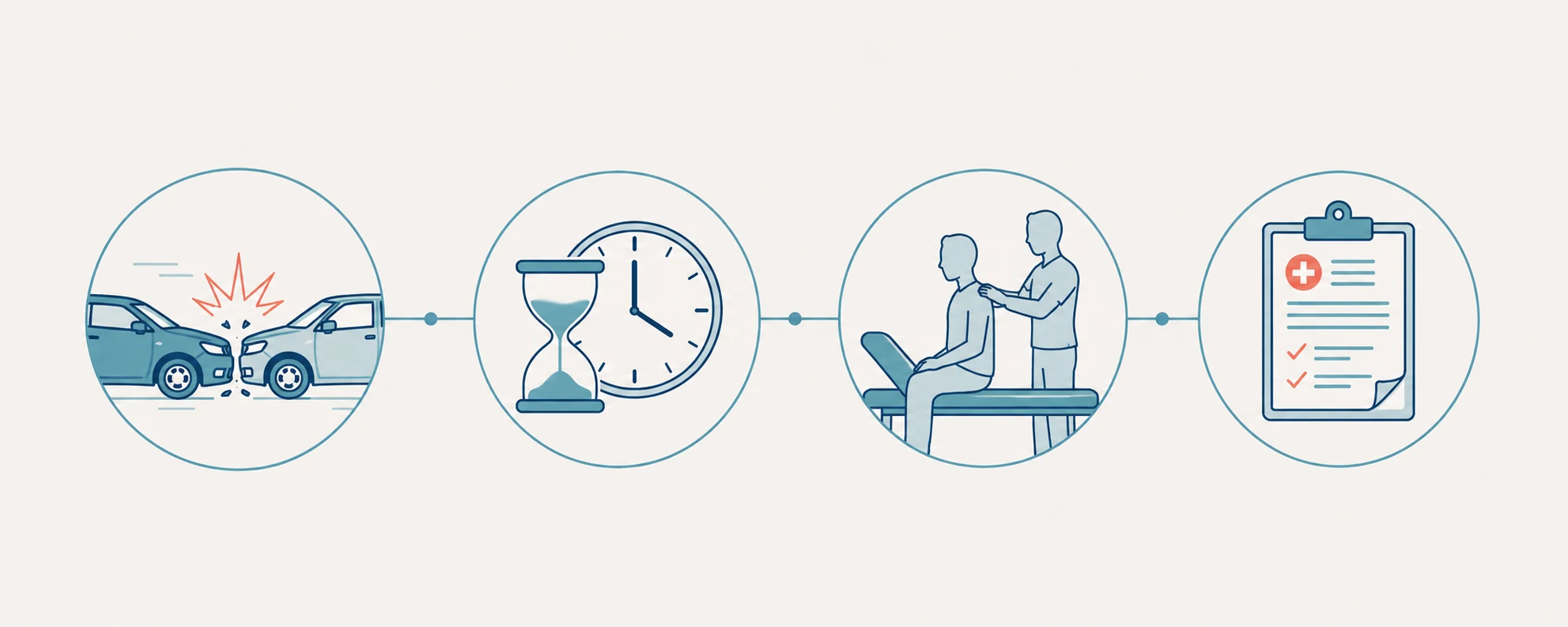
Timeline illustration showing the first 72 hours after a car accident

The first three days after a crash decide how the next three months go.

Adrenaline hides crash injuries for hours, sometimes days. The earlier you are evaluated and documented, the easier the injury is to treat and the cleaner the record protecting your claim. Same-day appointments available. Call (740) 453-2900.
Google4.6Based on 16 Google reviewsRead our 4.6-star Google reviews ↗

What to watch for after a crash

Crash injuries are sneaky. Adrenaline can hide them for hours or even days, so feeling okay right now does not mean you are in the clear. Get checked if any of these show up:

  • Neck pain, stiffness, or trouble turning your head
  • Headaches that started after the crash
  • Lower back pain or tightness
  • Tingling or numbness down your arms or legs
  • Dizziness, fatigue, or trouble sleeping
  • Shoulder, chest, or seatbelt-line soreness
Some of these can point to something that needs a physician rather than a chiropractor. If they do, we tell you straight and help you get to the right place fast. Neck pain after your crash? Read our full guide to whiplash treatment and what actually helps it heal.

How we help you recover

Your care is built around what the exam actually finds, not a one-size plan handed to everyone who walks in.
  • Hands-on chiropractic care for the spine and joints
  • Soft tissue therapy and rehab exercises to rebuild strength and motion
  • Guidance on movement, posture, and what to avoid while you heal
  • Imaging referral when the exam calls for it
  • Coordination with physicians and other providers for anything beyond our scope

Every kind of crash hits the body differently

To an insurance company, a crash is a crash. You know it did not feel that way. Getting rear-ended at a red light is a different experience, and a different injury, than getting hit from the side in an intersection. Here is what we tend to see after the most common kinds of crashes. However yours happened, we evaluate and document your injuries the same careful way.

Rear-ended, hit from behind. The most common crash, and the classic cause of whiplash. Your head snaps backward and forward before your muscles can brace, which strains the neck. We commonly see whiplash, neck pain and stiffness, headaches, and upper-back tightness, often showing up a day or two later.

T-boned, hit from the side at an intersection. The side of your body takes the impact with little between you and the other car. Side-impact crashes commonly cause neck strain, shoulder injuries from the seatbelt, rib and chest-wall pain, and lower-back or hip pain. Because the chest can be involved, these are worth getting checked promptly.

Head-on. The hardest hits, with the most force traveling through your body. Along with neck and back injuries, we often see chest and seatbelt injuries and concussion symptoms. Many head-on crashes need the emergency room first. Once you have been medically cleared, we pick up the accident-injury care.

Sideswiped or run off the road. The hit itself and the scramble to regain control both jolt the neck and back. Even when the cars barely touched, that sudden movement can strain soft tissue.

Rollover. Violent force from several directions at once. Neck and back injuries, shoulder injuries, and concussion symptoms are all common, and a rollover usually means an emergency-room visit first.

A minor fender bender. Do not let the size of the dent fool you. Even a low-speed crash can cause real whiplash and back strain, because the damage to the bumper does not tell you how much force reached your body. We explain why in a 15 mph crash bent the bumper, why does my back still hurt.

Hit and run, or hit by an impaired or distracted driver. When the other driver took off, or was drinking or looking at their phone, the crash carries an extra weight that is hard to put into words. Whatever the circumstances, your injuries are real, and getting evaluated and documented early matters. Our focus stays on your care and a clear, honest record of what you are dealing with.

Whatever kind of crash you were in, the next step is the same: get evaluated, get your injuries documented, and get a plan while everything is still fresh.

Why the first days matter so much

Two reasons, and both work in your favor if you come in early. First, your health: many crash injuries do not show their full colors for days, and catching them early keeps a small problem from hardening into a long one. Second, your record: an exam done close to the accident ties your injuries to the crash while that connection is still clear and hard to argue with. Wait too long and an insurer can claim your pain came from somewhere else. Early care protects both your body and your case. Not sure whether the ER or a chiropractor is the right first stop? Our post on how to tell the ER and a chiropractor apart walks through it, and if you want a plan you can actually see, read what a legitimate treatment plan looks like.
People Also Ask

Questions patients ask us most

How soon after a car accident should I see a chiropractor?

See an auto accident chiropractor within 72 hours of the crash. Adrenaline and inflammation can mask injuries like whiplash, soft tissue damage, and disc irritation in the first 24 to 48 hours. Early evaluation creates a clear medical record connected to the accident, helps prevent acute injuries from becoming chronic, and protects any insurance or personal injury claim you may file later.

What does an auto accident chiropractor actually do?

An auto accident chiropractor performs a focused exam for crash-related injuries, whiplash, neck and back strain, headaches, and disc and joint injuries, then builds a treatment plan that typically includes gentle spinal adjustments, soft tissue therapy, and rehab exercises. They also create detailed visit notes and progress reports that your auto insurance carrier, MedPay adjuster, or personal injury attorney can use to support your claim.

Will my car insurance pay for the chiropractor after an accident?

In most cases, yes. Medical Payments (MedPay) coverage on your own auto policy pays for chiropractic care regardless of who caused the accident, and at-fault liability coverage from the other driver typically reimburses care through a settlement. For qualifying cases we also accept a letter of protection so you can receive care now and payment comes from the final settlement.

Can a chiropractor help if I feel fine after the accident?

Yes, and that is exactly when an evaluation matters most. Many crash injuries do not produce noticeable pain for hours or days because adrenaline suppresses symptoms. A baseline auto accident chiropractic exam documents your range of motion, neurological responses, and any hidden injuries before they progress, which protects both your health and your claim.

How we work

What to expect

On your first visit, we listen to what is going on, run a focused exam, and start a clear record the same day. The plan is built around what the exam actually shows, not a template. If your situation points to something beyond chiropractic scope, we screen for it and refer you to the right provider so nothing gets missed.

Our practice handles two main paths. For patients recovering from a car accident or other injury, the focus is careful evaluation, real treatment, and documentation that holds up if your case involves an insurance claim or attorney coordination. For patients dealing with everyday neck pain, back pain, headaches, or posture concerns, the focus of our chiropractic care is finding the actual driver of the pain and treating it directly. Both paths get the same exam discipline and the same standards.

If you have an attorney, the clinic coordinates with them directly. If your accident case qualifies for a letter of protection, that option may be available so you can begin care now and address payment from the settlement at the end.

FAQ

Frequently Asked Questions

Quick answers about accident care, documentation, and what happens after you call.

Should I go to the ER first or straight to a chiropractor?

Go to the ER for any red-flag symptoms, loss of consciousness, severe headache, broken bones, abdominal pain, numbness, or weakness. For musculoskeletal injuries like neck, back, shoulder, or soft-tissue pain, a chiropractor is the right next step, often within 24 to 72 hours of the crash.

What should I bring to my first accident visit?

Bring a photo ID, your auto insurance card, the at-fault driver's insurance info if you have it, the police report or report number, your attorney's contact information if you have one, and a list of any medications you are taking.

Will I need imaging like X-ray or MRI?

Not always. Imaging is ordered when the exam findings suggest fracture, disc herniation, or neurological involvement, or when symptoms do not improve as expected. We will explain why before any referral is made.

How many visits will I need?

Most accident patients are seen 2 to 3 times per week early on, tapering as you improve. A typical plan runs 6 to 12 weeks and is reassessed at set intervals based on measurable progress, not a fixed schedule.

I got rear-ended and now my neck hurts. What should I do?

Rear-end crashes are the most common cause of whiplash, and the neck pain often shows up a day or two after the crash as the adrenaline wears off. Get evaluated so the injury can be examined, documented, and treated while it is still fresh and easier to settle down.

I got T-boned. What injuries should I watch for?

Side-impact crashes commonly cause neck strain, shoulder injuries from the seatbelt, and rib or chest-wall pain. Get checked promptly, and if you have trouble breathing or chest pain, treat that as an emergency and call 911 or go to the nearest emergency room.

Does it matter if it was just a minor fender bender?

No. Even a low-speed crash can strain your neck and back, and the damage to the car does not tell you how hurt you are. If you are sore or stiff after a minor crash, it is worth getting evaluated.

I was hit by a driver who took off, or who was drinking. Does that change my care?

Your care is the same no matter how the crash happened. We evaluate your injuries, document them carefully from the first visit, and treat what is within our scope.

Free Guide

The Muskingum County Accident Recovery Guide

What to do in the first 72 hours, the 3 AI prompts every accident victim should ask, and the questions to ask before you sign anything. Free, no spam.

Helpful resource: get your Ohio crash report from the official Ohio Department of Public Safety portal.

See the full list: all accident injuries we treat, including whiplash, neck pain, back pain, disc injury, headaches, sciatica, shoulder injuries, and concussion and post-concussion care.

Not sure where to start? Read chiropractor vs. ER after a car accident for the plain-English call on which one fits your symptoms, and how car accident insurance works in Ohio for how the care actually gets paid.

Communities we serve: we treat crash patients from across Muskingum County and beyond, including South Zanesville, Norwich, New Concord, Roseville, Crooksville, Dresden, Frazeysburg, Philo, Nashport, and Cambridge.

If your case is broader than a crash — a fall, a work injury, or a mix of incidents — the personal injury chiropractor page covers that same documentation workflow for non-auto cases. For everyday aches and posture issues unrelated to a crash, see our general chiropractic care page. For qualifying accident patients we can defer payment on a letter of protection, and attorneys handling Ohio accident cases can see exactly how we coordinate records and timelines.

Related injuries we treat: whiplash, neck pain, and back pain. We see accident patients from Zanesville, Cambridge, New Concord, Dresden, and Crooksville. Same-day appointments and walk-ins welcome.

New to these terms? See our personal injury glossary.

Hurt in a crash? Do not wait it out

Get evaluated, get it documented, and get a clear plan, often the same day. The sooner you are seen, the better for your recovery and your record. Call (740) 453-2900 or request an appointment now.