
What to Do in the First Days After a Car Accident
Published
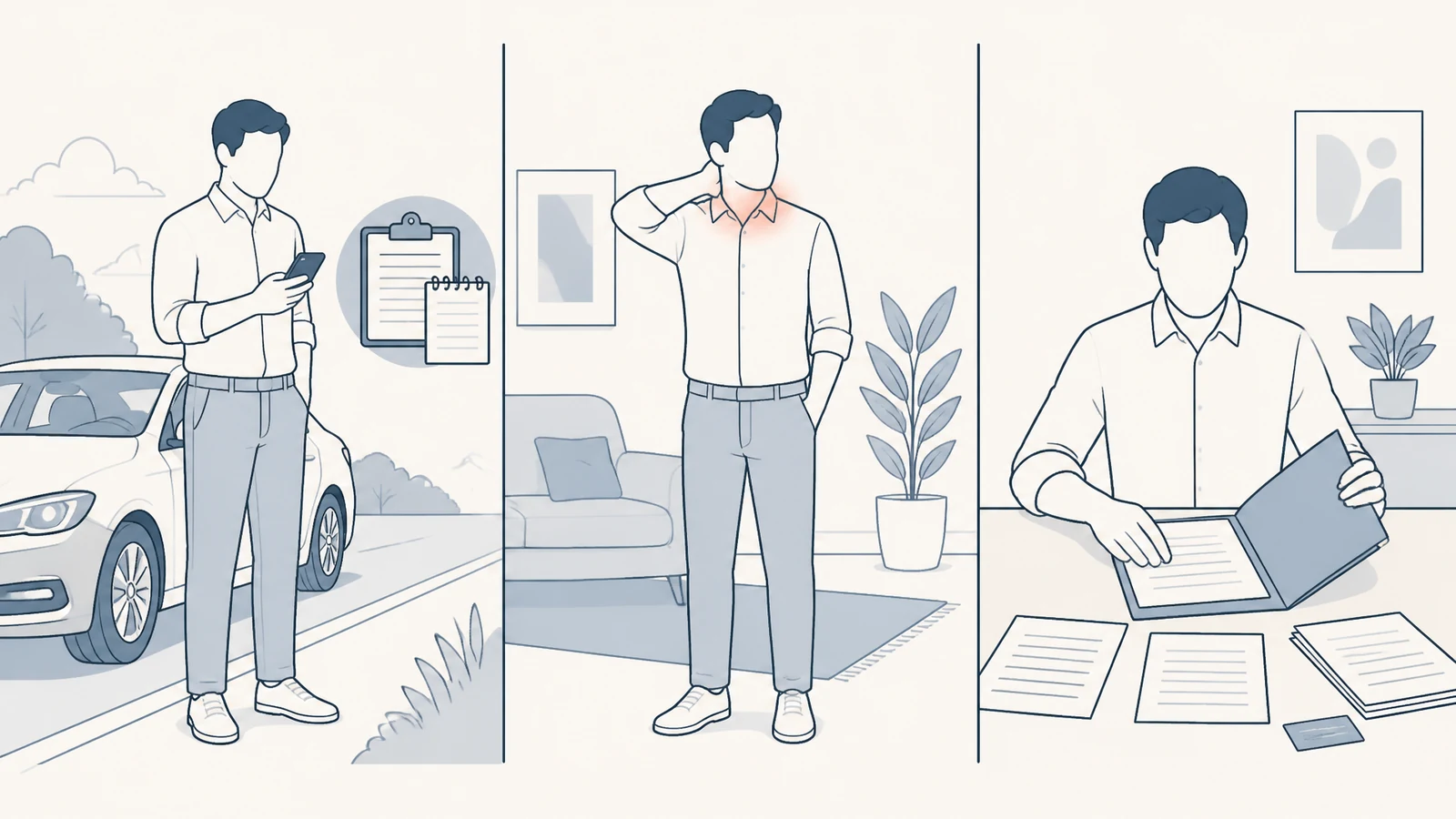
The first days are for safety and organization, not racing a countdown clock.
There is no magic 24-hour or 72-hour deadline that decides whether you will recover well or whether an injury is real. The first few days matter for a simpler reason: this is when you are sorting out safety, symptoms, transportation, paperwork, and whether you need follow-up care. Use this as a practical checklist, not a countdown clock.
Ohio Public-Road Requirement
What Ohio law actually says about stopping and exchanging information
For an accident or collision involving persons or property on a public road or highway, Ohio Revised Code 4549.02 says a driver who knows the crash occurred must stop at the scene and remain there while providing the driver's name and address, the owner's name and address if the driver is not the owner, and the vehicle's registered number to the people specified in the statute or to the police officer at the scene.
The statute also addresses a situation where an injured person cannot comprehend and record that information. In that circumstance, the other operator must notify the nearest police authority with the crash location and the operator and vehicle information required by the statute, and remain at the scene until a police officer arrives unless removed by an emergency vehicle or ambulance.
Ohio Revised Code 4549.02: Stopping after an accident on public roads or highways
That is a legal source for the public-road stop-and-information duty, not individualized legal advice. Different facts can trigger other rules. The practical point for this guide is simple: handle immediate safety first, follow law-enforcement instructions, and use the official Ohio source instead of relying on a social-media checklist for what the statute requires.
First, decide whether you need emergency care
Call 911 or go to an emergency department for emergency warning signs such as loss of consciousness, increasing confusion, a worsening headache, repeated vomiting, seizure, slurred speech, new weakness or numbness, trouble breathing, severe chest or abdominal pain, heavy bleeding, or a suspected fracture.
For a possible head injury, review the CDC's concussion danger signs. If those signs are present, do not wait for a scheduled chiropractic appointment.
If it is not an emergency, pay attention to what changes
Some people feel sore immediately. Others notice stiffness, headaches, back pain, shoulder soreness, dizziness, or other symptoms later. The timing varies. Write down what changed and when, but do not try to diagnose yourself from a checklist.
If new symptoms appear, existing symptoms worsen, or something simply concerns you, contact an appropriate clinician. For non-emergency neck, back, joint, or soft-tissue symptoms, our car accident chiropractor page explains what a chiropractic evaluation can and cannot address.
Keep a simple record for yourself
Put the crash-report number, discharge papers, imaging reports, insurance information, appointment summaries, and receipts in one place. If symptoms are changing, a short daily note about what you are feeling and what activities are difficult can help you give a more accurate history at follow-up visits.
The point is accuracy. A useful medical record reflects what you reported, what a clinician found, and what care was provided. It should not be written to exaggerate a claim or manufacture a story.
Arrange follow-up for symptoms that persist or appear later
You do not need to choose a provider based on a slogan or a deadline. The right follow-up depends on the symptom. Primary care, chiropractic care, physical therapy, imaging, or a specialist may all be reasonable in different situations. Emergency warning signs still belong in emergency care.
If the problem is non-emergency musculoskeletal pain, stiffness, or reduced motion after a collision, a chiropractic exam may be one appropriate option. A responsible chiropractor should also recognize when the findings need another provider.
Ask what the care plan is trying to accomplish
Before agreeing to a schedule, ask what the exam found, what the goals are, why a certain visit frequency is being recommended, when progress will be reassessed, and what would cause the plan to change. A legitimate treatment plan should make sense when someone explains it in plain English.
Our article on what a legitimate accident treatment plan looks like gives you a practical way to evaluate those answers.
Use official Ohio resources when you need them
You can retrieve an Ohio crash report through the Ohio Department of Public Safety. For payment questions, our Ohio car accident insurance guide explains common terms and the questions to ask your insurer or the clinic before assuming something is covered.
The Ohio crash portal also explains that the investigating agency is the official record keeper for the official report and supplemental information.