

Whiplash Treatment: What Actually Helps After a Car Accident
Published
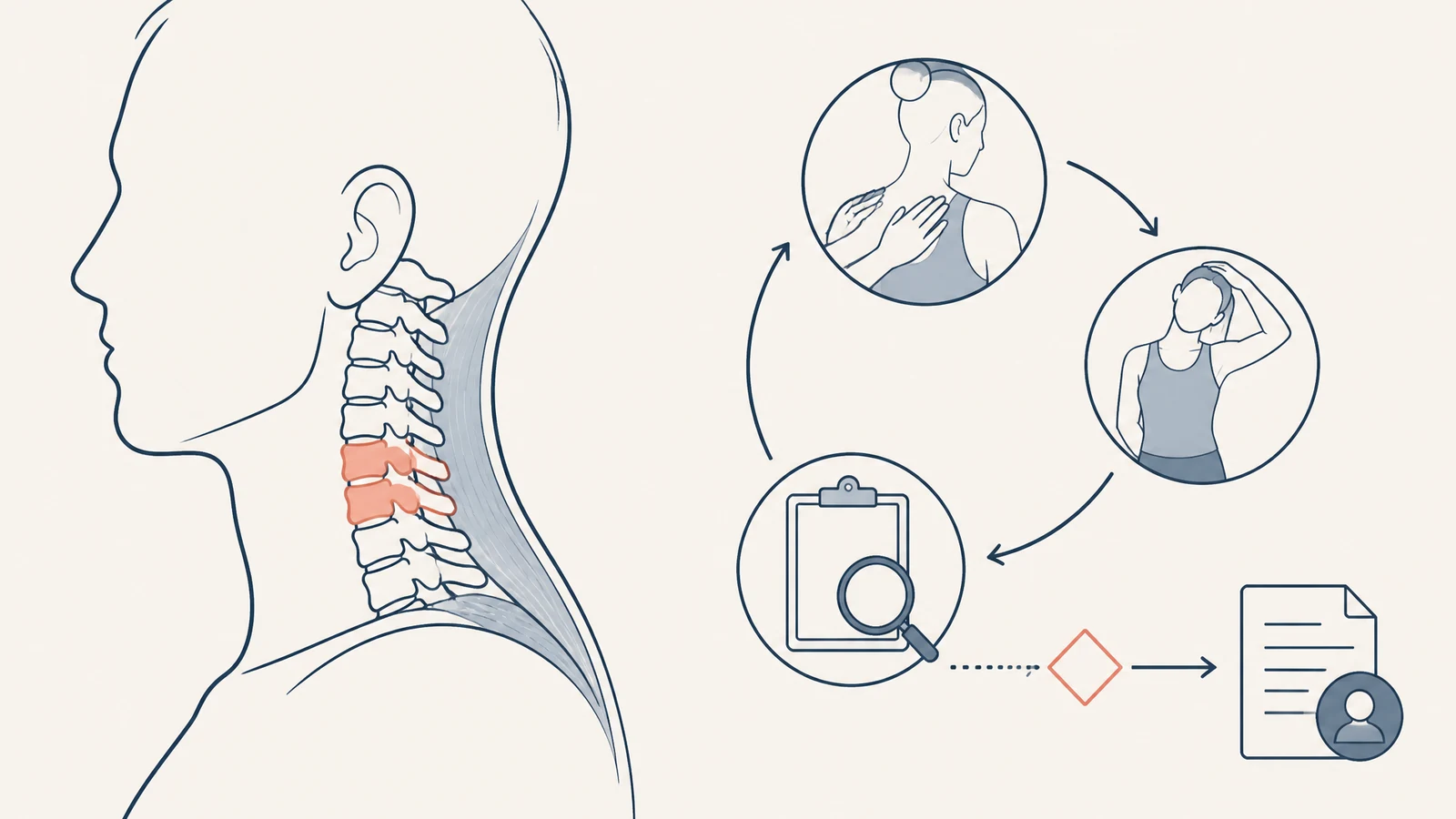
Whiplash care should follow findings and reassessment, not a preset schedule.
Whiplash does not have one magic treatment, one fixed number of visits, or one recovery timeline that fits every person. The useful starting point is a careful evaluation: what happened, what symptoms you have, what the exam finds, whether any warning signs need another level of care, and what the treatment plan is actually trying to improve.
What the word whiplash means
Whiplash is commonly used to describe neck-injury symptoms after rapid acceleration and deceleration, often during a collision. The crash description provides context, but it does not diagnose the injured tissue or tell a clinician how severe the problem is. Neck pain, stiffness, reduced motion, headaches, shoulder soreness, numbness, or weakness can require different levels of evaluation depending on the pattern.
Crash mechanics give context, not a diagnosis
Rear-impact research is useful because it helps explain why clinicians ask about impact direction, seat position, head restraint position, and how the occupant moved. NHTSA's biomechanics research examines head and neck motion in rear impacts and other crash conditions. That engineering work supports asking better history questions. It does not support diagnosing a person from the phrase "rear-ended" or from the amount of visible vehicle damage.
For readers who want the engineering source rather than a clinic summary, see NHTSA's biomechanics research. The medical decision still depends on symptoms, examination findings, neurological findings, red-flag screening, and appropriate testing.
The plan should have clear reasons to change
A useful whiplash plan is not just a list of treatments. It also explains the conditions that would change the next step. Improvement in motion or function may support reducing or changing care. New neurological findings, worsening symptoms, a different headache pattern, or failure to progress may support reassessment, imaging, referral, or another medical opinion depending on the situation.
That is why a fixed package is less informative than a plan with decision points. The patient should be able to ask, "What are we watching, and what would make us do something different?" and receive a concrete answer.
Start with safety, not a treatment technique
A worsening headache, repeated vomiting, seizure, increasing confusion, slurred speech, new weakness or numbness, unequal pupils, difficulty waking, or other emergency warning signs after a possible head injury need emergency medical evaluation. Suspected fracture or significant neurological change also requires the appropriate medical level of care.
The CDC publishes current concussion danger signs for people who want an official reference.
Conservative care can include more than one approach
When the findings fit non-emergency musculoskeletal care, conservative options may include appropriate hands-on care, exercise or movement guidance, soft-tissue work, activity modification, and time. Spinal manipulation is one option used for some musculoskeletal problems, not a cure-all and not a substitute for emergency or other medical care.
The National Center for Complementary and Integrative Health provides a balanced overview of spinal manipulation, including evidence, limitations, and safety considerations.
Avoid preset treatment packages
A treatment schedule should follow the examination and the patient's response, not the fact that a crash occurred. Ask why a certain visit frequency is recommended, what the goals are, when progress will be reassessed, and what would cause the plan to taper, change, or involve another provider.
Improvement should be measured in ways you can understand
Pain is one part of the picture. Range of motion, sleep, tolerance for driving or sitting, ability to work, strength, and return to normal activities can also help show whether the plan is working. If progress does not match expectations, the explanation and treatment approach should be reconsidered rather than continuing unchanged by default.
Questions worth asking before you start
- What did the exam actually find?
- Why does the proposed treatment fit those findings?
- What are the goals of the plan?
- Why is this visit frequency being recommended?
- When will progress be reassessed?
- What findings would cause imaging, referral, or another medical provider to be involved?