

Why Car Accident Pain Can Show Up Later
Published
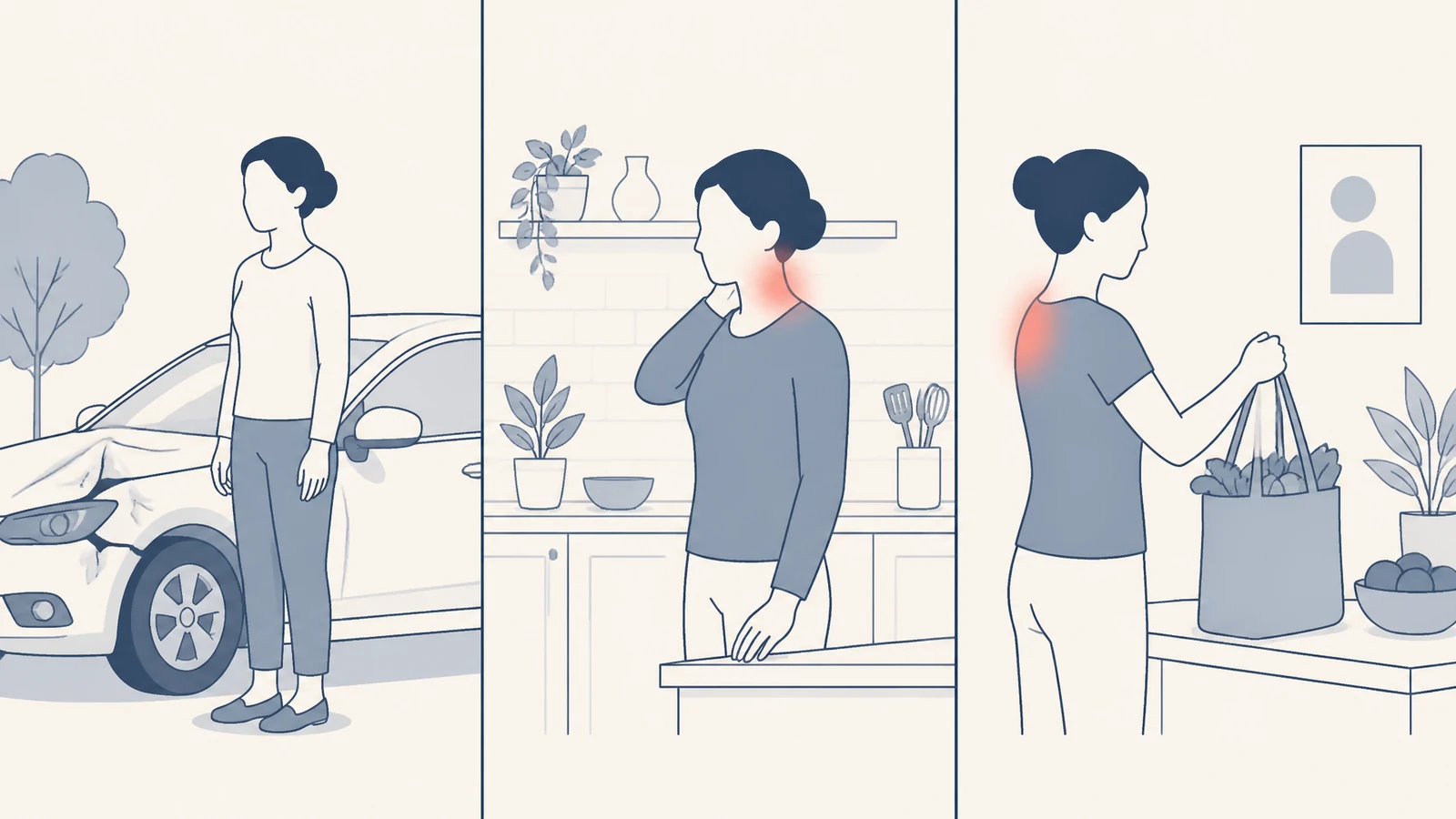
Symptoms can become noticeable later without creating a medical countdown clock.
Some people hurt immediately after a crash. Others notice neck pain, back pain, headaches, stiffness, dizziness, shoulder soreness, numbness, or other symptoms later. There is no single explanation or timetable that fits everyone. The important point is to notice what changed, describe it accurately, and use the right level of care for the symptoms you actually have.
Why symptom timing can vary
A collision can involve multiple tissues, positions, and forces, and people do not all experience symptoms in the same way. Activity after the crash, sleep, muscle soreness, stress, preexisting conditions, and the natural evolution of an injury can all affect when a symptom becomes noticeable. Timing by itself does not diagnose the problem and does not prove how serious it is.
Head-injury symptoms are especially important to watch
The CDC notes that some mild traumatic brain injury and concussion symptoms may appear right away while others may not appear for hours or days. A worsening headache, repeated vomiting, seizure, increasing confusion, slurred speech, weakness or numbness, unequal pupils, or difficulty waking are danger signs that require emergency medical care.
Write down changes without trying to diagnose yourself
A short note can help you give a clearer history: what symptom appeared, when you first noticed it, what makes it better or worse, whether it is changing, and what normal activities are harder. That is more useful than trying to attach a diagnosis to yourself from an online checklist.
A symptom-change log is more useful than a pain countdown
If a symptom becomes noticeable later, the useful record is not just the date. Capture what changed. A short symptom-change log can give a clinician more usable information than a vague statement that you "started hurting later."
- The symptom and the body area where you notice it
- When you first became aware of it, without guessing when an injury "must have started"
- Whether the symptom is stable, improving, worsening, or coming and going
- Which normal activities now feel different, such as turning to check a blind spot, getting out of a chair, sleeping, lifting groceries, or sitting through work
- Any associated changes such as dizziness, numbness, weakness, nausea, balance trouble, or a different headache pattern
This creates a cleaner distinction between observation and diagnosis. "My neck became stiff when I turned left this morning" is an observation. "The crash tore a ligament" is a diagnosis that requires clinical support. Keeping those two things separate makes the history more accurate and more useful.
Three questions should not be collapsed into one
Delayed symptoms often get discussed as though timing answers everything. It does not. There are at least three separate questions: Is the symptom an emergency? What medical or musculoskeletal problem may explain it? What type of follow-up is appropriate? A later start does not automatically answer any of those questions.
That distinction is especially important with headaches, dizziness, neurological changes, chest or abdominal symptoms, and breathing problems because the safest next step may be different from the next step for ordinary muscle stiffness. Use the symptom itself and the warning-sign screen to choose the level of care, not a clock.
When non-emergency follow-up may make sense
If you are medically stable but develop persistent neck pain, back pain, stiffness, reduced motion, or other musculoskeletal symptoms, arrange an appropriate evaluation. Depending on the findings, follow-up may involve primary care, chiropractic care, physical therapy, imaging, or another provider. Our car accident chiropractor page explains what our office evaluates and when we refer out.
Do not turn timing into a legal rule
There is no universal 24-hour or 72-hour rule that decides whether an injury is real or whether care is appropriate. Medical records should accurately reflect the symptoms you reported, the examination findings, and the care provided. Insurance coverage and legal questions should be verified separately with the insurer or an attorney when appropriate.